Giving students a path to success

By PERRI ORMONT BLUMBERG
25 Mar 2026
MICHAEL Piscal, founder and CEO of College Achieve Public Schools, remembers sitting in the front office of the first charter school he opened in New Jersey, the College Achieve Central Charter School in Plainfield, when a fifth grader came in and asked him, “Mr. Piscal, what do you do here?”
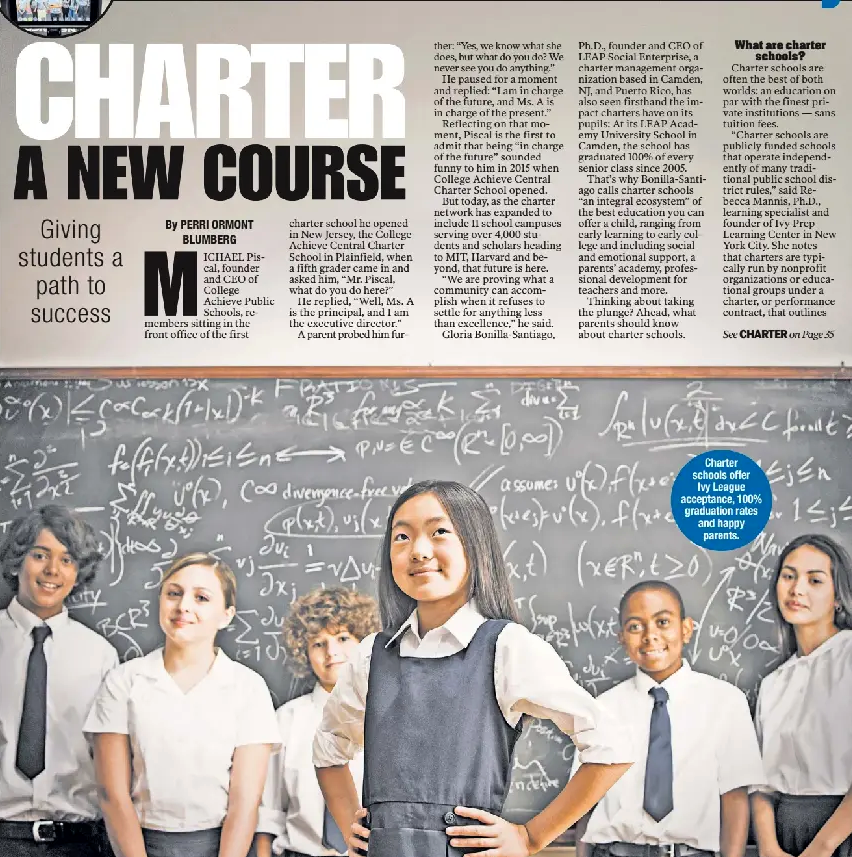
Charter schools offer Ivy League acceptance, 100% graduation rates and happy parents.
He replied, “Well, Ms. A is the principal, and I am the executive director.”
A parent probed him further: “Yes, we know what she does, but what do you do? We never see you do anything.”
He paused for a moment and replied: “I am in charge of the future, and Ms. A is in charge of the present.”
Reflecting on that moment, Piscal is the first to admit that being “in charge of the future” sounded funny to him in 2015 when College Achieve Central Charter School opened.
But today, as the charter network has expanded to include 11 school campuses serving over 4,000 students and scholars heading to MIT, Harvard and beyond, that future is here.
“We are proving what a community can accomplish when it refuses to settle for anything less than excellence,” he said.
Gloria Bonilla‑Santiago, Ph.D., founder and CEO of LEAP Social Enterprise, a charter management organization based in Camden, NJ, and Puerto Rico, has also seen firsthand the impact charters have on its pupils: At its LEAP Academy University School in Camden, the school has graduated 100% of every senior class since 2005.
That’s why Bonilla‑Santiago calls charter schools “an integral ecosystem” of the best education you can offer a child, ranging from early learning to early college and including social and emotional support, a parents’ academy, professional development for teachers and more.
Thinking about taking the plunge? Ahead, what parents should know about charter schools.
What are charter schools?
Charter schools are often the best of both worlds: an education on par with the finest private institutions — sans tuition fees.
“Charter schools are publicly funded schools that operate independently of many traditional public school district rules,” said Rebecca Mannis, Ph.D., learning specialist and founder of Ivy Prep Learning Center in New York City. She notes that charters are typically run by nonprofit organizations or educational groups under a charter, or performance contract, that outlines specific academic goals and accountability measures.

Charter schools offer small class sizes and a safe, inclusive atmosphere.
“Unlike private schools, charter schools are free and open to the public, but they often have greater flexibility in curriculum design, teaching methods and school culture compared to traditional public schools,” she further explained.
Piscal put it a bit more bluntly, saying a charter school is “a mad visionary adventure of a whole community of teachers, parents and students, with no money for facilities, about $4,000 less [spent] per student than traditional public schools and no funds for transportation.”
In all seriousness, though, Piscal stressed that public charter schools are in many ways the most American of all ideas, and legislatures across the country decided that public education needed a strong dose of innovation, competition and “schools of choice.”
“From one charter school in 1992 to over 8,000 public charter schools today, the growth has given millions of low-income and black and Latino families schools of choice, an option previously only available to the wealthy and privileged,” he said, adding that there are approximately 32,000 students on charter school waiting lists in New Jersey, and roughly five times that number in New York City.
With many public schools failing our youth, charter schools may prove a brighter alternative for many families. Bonilla-Santiago emphasized that charter schools have a project‑based approach to teaching and learning, standing out from traditional public schools in their capacity to care for children, intentionally hire the best teachers, listen to parents’ choices and further innovation.
“They do whatever it takes mentally to get kids to learn,” she said.
Why choose a charter?
That all sounds dandy, but most parents have the same thought: “OK, but why should I send my kid to a charter?”
Per Mannis, many parents choose charter schools because they often offer innovative teaching models, a strong focus on measurable academic outcomes and a clearly defined educational mission.
“For families seeking an environment that emphasizes structured skill development, particularly in foundational areas like literacy and math, charter schools can provide an appealing alternative to traditional district options,” she said.
The flexibility beyond what a traditional public school can offer is also a big draw.
“Flexibility means charter schools can implement different instructional approaches, curriculum structures and scheduling models without many of the bureaucratic constraints of traditional districts,” said Mannis, noting that this can allow schools to adopt evidence‑based literacy programs, extend learning time or create specialized academic tracks. Some students can even earn college credits while in high school. “When used well, this flexibility allows educators to focus more directly on skill mastery and measurable student outcomes,” she said.
Speaking of tangible metrics, you want your kid to go to college and earn a good living one day, right? According to Georgetown University, bachelor’s degree holders earn a median of $2.8 million during the course of their career, which is 75% more than those who have only a high school diploma.
Piscal believes a proper American education system would give all students the option and opportunity to attend college. Clearly, that’s not the case — but charters can be the change agent.
“In many towns and cities, a public charter school is the surest way for a student to get to college (often on a scholarship) and through college (to graduate with a bachelor’s degree),” said Piscal.
Even better, charter schools can admit students from an entire district, city and beyond without a test to get in, unlike magnet schools. “Students are admitted on a first‑come, first‑served basis, unless there is a waiting list, in which case the charter school must conduct a lottery,” explained Piscal. “So, who can attend a charter school is far more flexible than in neighborhood‑assigned or test‑in schools.”
Bonilla‑Santiago additionally singles out charters for being safe schools and providing students with small classroom sizes.
“Charter schools are innovative in crafting their curriculum and days, allowing parents to participate in student learning,” she said.
Piscal ties this back to the freedom charter schools have to be innovative. “Charter schools can create their own curricula as long as their students’ test scores outpace those of their districts of residence,” he said.
Next steps
If you’re interested in sending your child to a charter school, it’s time to get the show on the road.
Cindy Chanin, founder and CEO of Rainbow EDU Consulting & Tutoring in New York and Los Angeles, tells parents to attend an open house, take a tour and listen closely to how leadership speaks about expectations and growth.
“Ask how they support students who need an extra challenge or those who need additional support,” and learn what a typical day actually looks like, Chanin said. “If possible, bring your child.”
If relevant, Mannis said to ask how the school supports students with learning differences or exceptional abilities to ensure the environment is the right match.
“As charter schools continue to evolve, expanding their focus on individualized learning will be key to their future impact,” she said. “Recognizing diverse learning profiles including students with dyslexia, ADHD and twice‑exceptional learners” – so‑called 2e students, who are intellectually gifted and neurodivergent – “can help ensure that the movement’s strong commitment to outcomes benefits an even wider range of students,” said Mannis.
That said, Mannis reiterated that charter schools can be a great fit for students who thrive in structured environments that emphasize clear academic expectations and skill development.
Piscal echoes that sentiment.
“Charter schools aren’t just an alternative; they are an opportunity,” he said.